University of Louisville Social Work Admin Says DEI Is Protected Through Accreditation Despite Kentucky Ban
April 1, 2026
Despite Kentucky’s ban on Diversity, Equity, and Inclusion programs in higher education, DEI content may not be explicitly prohibited from coursework under HB4—raising questions about whether universities can continue advancing the same material under different language, potentially bypassing the intent of the law.
So, Accuracy in Media sent an undercover investigator to the University of Louisville to find out whether the university is complying with state law.
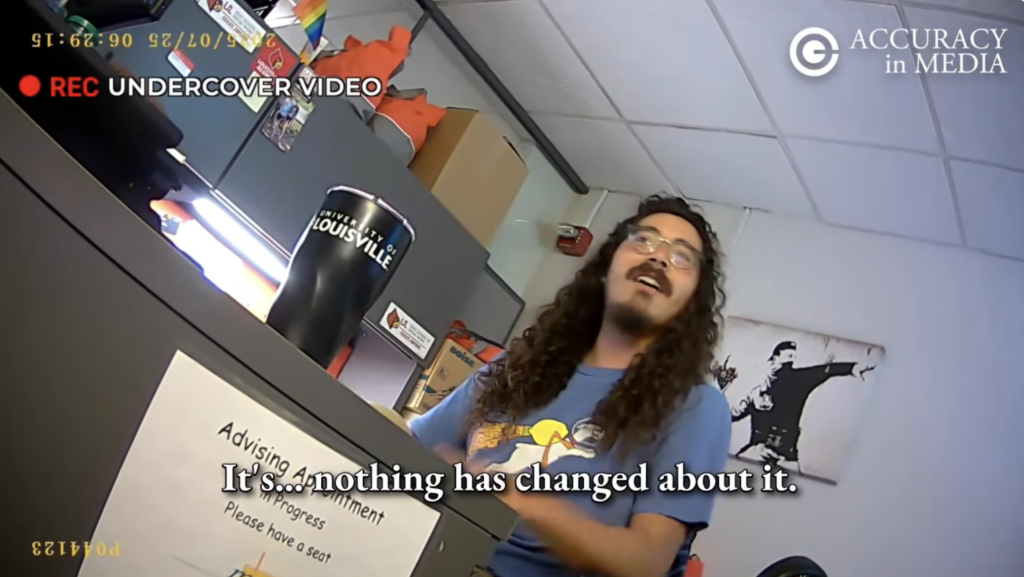
Posing as a prospective student, our investigator met with Bobby Cortes, an Admissions Coordinator for the Kent School of Social Work and Family Science, who spoke openly about the political climate in Kentucky and the role DEI plays in social work education.
Cortes described Kentucky as “super conservative,” but claimed that Louisville and Lexington are different due to their higher levels of education and their larger populations. He then acknowledged that social work practices are rooted in ideological concepts often associated with DEI.
Cortes then stated that “it’s been very difficult with all this HB4 stuff here in Kentucky to keep my personal feelings away from my professional matter.” In other words, administrators openly admit that their personal politics potentially affect their professional responsibility to uphold state law.
Later, when the investigator expressed concern about attending a university where DEI may no longer be part of the program, Cortes stressed that the DEI elements of Kent School’s curriculum continue to be taught, protected by accrediting bodies.
“Something I tell students who are also concerned about these things is, with the School of Social Work, it’s written into our accreditation,” he said. “Courses on oppression, courses on diversity, antiracism practices and theories… Those are written into our curriculum. So those are protected under our accreditation.”
Cortes also admitted the university has adjusted its language to avoid scrutiny under the new law.
“The university has had to change their verbiage,” he said, referencing “keywords” that could raise “red flags.”
Cortes gave an example involving a university committee focused on race-based initiatives.
“So, we had an antiracism committee that now had to change their name to something different,” Cortes said. “Nothing has changed about it. But the verbiage, to not get those keywords, those red flags to kind of pop out.”
When the investigator asked if the same values were still being promoted, Cortes replied emphatically, “Absolutely. Absolutely. Absolutely.”
Accuracy in Media has raised concerns that while DEI content may not be explicitly banned from coursework under HB4, the effort to conceal DEI-related activities through strategic rewording suggests that the university may be attempting to bypass the intent of the law.
Accuracy in Media President Adam Guillette questioned why such committees and curriculum content are still being defended under the guise of accreditation, and whether professors and administrators are using the accreditation process as a loophole to continue their ideological activism.
Take action now by visiting DEIinKentucky.com, where you can send a message directly to the trustees of the University of Louisville.