Director of Social Work at NKU Says Accreditation “Protects” DEI Curriculum Despite Ban
April 15, 2026
Despite a state and federal ban on Diversity, Equity, and Inclusion programs in higher education, an administrator at Northern Kentucky University suggests the ideology remains embedded in both coursework and structure, shielded by accreditation requirements.
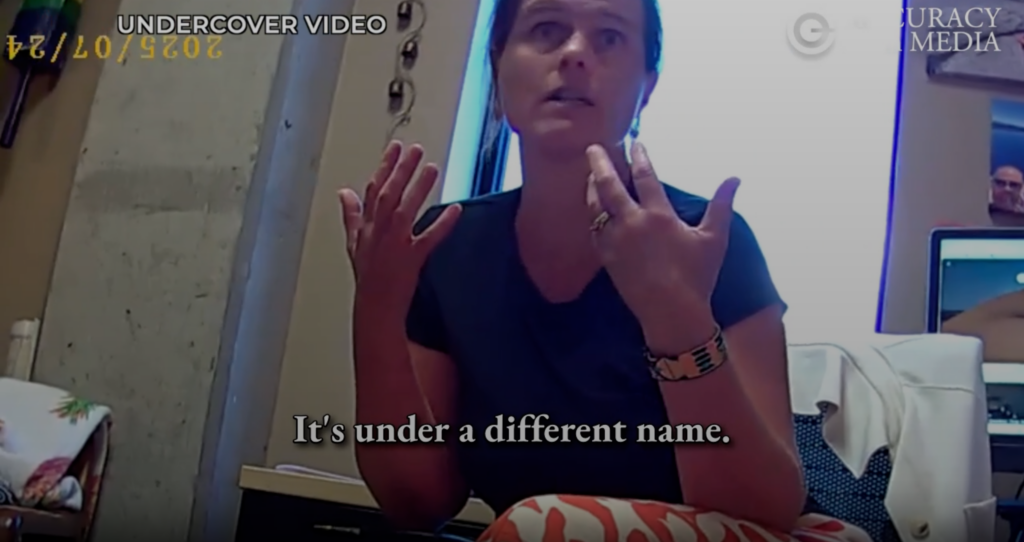
Accuracy in Media sent an undercover investigator to Northern Kentucky University to find out if the school is complying with House Bill 4, restricting DEI-related initiatives. The investigator met with Dr. Caroline Macke, Director of the School of Social Work, who spoke candidly about how the university has adapted.
Macke framed DEI not as a discretionary component of education, but as foundational to the discipline itself.
“One of the beautiful things about social work is that we focus on all of those things… it’s central to everything that we do. And the beauty of it is, despite whatever is going on in the outside world and the larger kind of political climate, we continue to focus on that.”
While NKU has formally eliminated certain identity-based offices in response to the law, Macke acknowledged that the underlying functions—and personnel—remain intact under new branding.
“Those no longer exist because of House Bill 4. So what NKU has done… is the people who ran those centers, none of them have been let go. They restructured in a way that we’re following the law. So we’re still able to serve our students in the same way that we were.”
She pointed to the creation of the “Norse Center for Belonging” as an example of this transition.
“They were telling the university community, ‘hey we still exist, it’s under a different name. We’re still here.’”
Macke also made clear that, in her view, the political shift against DEI is misguided.
“Terms like Social Justice, Inclusion, Diversity have all been flagged… I don’t even know how that’s possible. It’s ludicrous.”
Perhaps most notably, Macke stated that accreditation standards provide a form of insulation from state and federal policy changes. According to her, the Council on Social Work Education (CSWE) mandates DEI-related instruction as part of its required competencies.
“Our accrediting body… requires us to teach nine competencies and one of those focuses exclusively on Diversity, Equity, and Inclusion. It’s literally a core part of our curriculum… it offers our program a lot of protection.”
She added that this requirement effectively limits the university’s obligation or ability to alter coursework in response to new laws.
“Because what’s going on at the state level or at the federal level can’t influence our curriculum… we have not made any changes nor do we plan to because it’s central to what we do.”
While Kentucky’s law has prompted structural changes on paper, the principles and programming associated with DEI persist through rebranding and accreditation frameworks and radical administrators.
Take action now by visiting DEIinKentucky.com to send one message directly to relevant elected officials and demand accountability. No taxpayer should be forced to fund programs that operate in defiance of state law.